E-time | the software company


INDEX
- Orphan accounts: what are they and why do they represent a risk?
- How are orphan accounts created in corporate systems?
- What is the difference between orphan, inactive and disabled accounts?
- What risks do orphan accounts pose to cybersecurity?
- How to identify and prevent orphan accounts with IAM systems?
- How do IAM and IGA automate provisioning and deprovisioning?
Orphan accounts: what are they and why do they represent a risk?
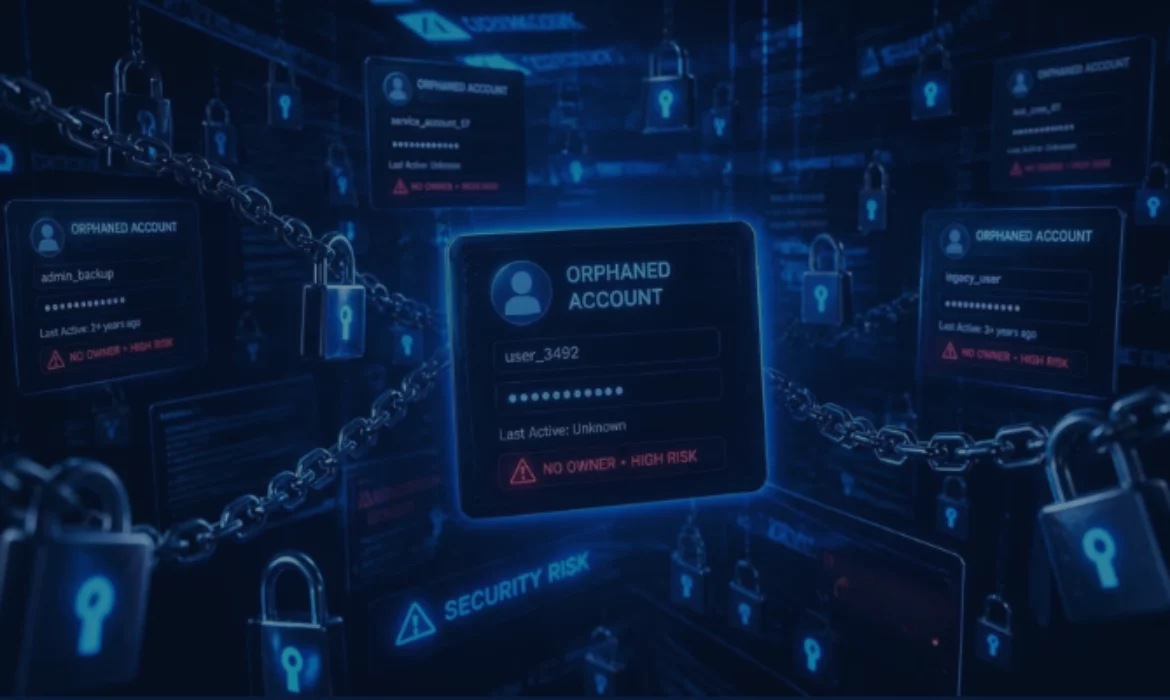
Orphan accounts are accounts that continue to be present and, in some cases, active within directories, applications and corporate systems even when the person they were associated with no longer works for the organization or no longer holds the role that justified their access. The problem therefore arises from the lack of an effectively responsible account owner, who may continue to have the previously assigned permissions.
These identities represent a security risk because they combine lack of control, potentially unnecessary permissions and limited visibility into activities. An account that is not properly deactivated can in fact become an access point to corporate resources and sensitive data, increasing the risk of improper use by former employees or external parties.
How are orphan accounts created in corporate systems?
Orphan accounts are often the result of a poorly coordinated management of the user lifecycle. One of the most common cases occurs when an employee’s departure is not promptly communicated to IT teams or when account deactivation has to be carried out manually across numerous systems and applications.
The problem can also arise in connection with role changes, corporate reorganizations or internal transfers, when old permissions are not removed and accumulate over time. Other cases involve collaborators, consultants and suppliers who are assigned temporary accounts that are not revoked when the relationship ends. System migrations, mergers and acquisitions can also contribute to the persistence of accounts that are no longer associated with active users, especially when the different infrastructures are not properly aligned.
What is the difference between orphan, inactive and disabled accounts?
Although they may seem like similar situations, orphan, inactive and disabled accounts describe different conditions:
- Orphan account: it is still present and potentially active in a system, but is no longer associated with a person or a manager who has a current role in the organization.
- Inactive account: it belongs to an identifiable user, but has not been used for an extended period. However, the user may still be part of the organization.
- Disabled account: it has been explicitly suspended or deactivated and should therefore not allow access. However, if the deactivation is not completed correctly, processes or active authorizations may remain, giving rise to the so-called zombie account.
Distinguishing between these situations is important to determine which action to take and correctly assess the level of risk associated with each account.
What risks do orphan accounts pose to cybersecurity?
The presence of orphan accounts can significantly increase an organization’s attack surface. Accounts that still have credentials and authorizations can in fact be exploited to gain unauthorized access and reach corporate data or systems, with potential economic, operational and reputational consequences.
The risk also concerns regulatory compliance, as inadequate access management can create issues with requirements established by regulations and standards such as GDPR, SOX and HIPAA. Added to this are difficulties during audits, the need to dedicate resources to monitoring accounts that are no longer necessary and the risk of insider threats, especially when credentials belong to former employees or collaborators.
Orphan accounts can also be exploited by attackers as low-visibility entry points. Techniques such as credential stuffing and password guessing, or the use of already compromised credentials.
How to identify and prevent orphan accounts with IAM systems?
IAM and IGA systems can identify orphan accounts through automated reconciliation processes, comparing the accounts present in directories and applications with company data, such as data coming from the HR system. When an active account associated with an identity that is no longer present or active is detected, the system can flag it and initiate verification, deactivation or removal procedures.
Prevention instead relies on the automation of the identity lifecycle (Joiner-Mover-Leaver), connecting HR processes to the IT infrastructure so that any change relating to an employee is promptly reflected in their access.
rifletta tempestivamente sui suoi accessi.
Provisioning and deprovisioning, together with RBAC, the least privilege principle and temporary account management, make it possible to keep access up to date. Features such as SSO and MFA also help strengthen security and reduce the risk associated with unused credentials.
How do IAM and IGA automate provisioning and deprovisioning?
IAM and IGA systems automate identity lifecycle management, reducing manual intervention and the risk of orphan accounts. Through integration with HR systems, directories and applications, they can trigger automated workflows for the creation, modification and revocation of access, assigning users the permissions required according to their role and removing them when they are no longer authorized.
Yookey, based on Keycloak, integrates natively with YooPoint, E-time’s IGA solution, to support identity and access lifecycle management. This integration makes it possible to coordinate provisioning and deprovisioning processes, helping ensure that access is assigned and revoked consistently and promptly.