> Auto-generated markdown. For the original HTML, request the same URL without `Accept: text/markdown`, removing any `.index.md` or `/index.md` suffix.
E-time | the software company
[Linkedin-in](https://www.linkedin.com/company/e-time-s-r-l-/) [Facebook-f](https://it-it.facebook.com/etime.engineering/) [Instagram](https://www.instagram.com/_etimesrl_/)
[](https://www.e-time.it/index.md)
# Other
[](https://www.e-time.it/en/odoo-vs-salesforce-5-reasons-to-choose-odoo/index.md)
August 17, 2023by [user](https://www.e-time.it/en/author/user/index.md)[News](https://www.e-time.it/en/category/news-en/index.md)[Other](https://www.e-time.it/en/category/other/index.md)
## [Odoo vs Salesforce: 5 reasons to choose Odoo](https://www.e-time.it/en/odoo-vs-salesforce-5-reasons-to-choose-odoo/index.md)
**Salesforce** represents one of the historical brands among the CRM systems in the market, while **Odoo** is a relatively recent player (relatively, because the software’s origin although significantly different from the current product dates back to 2005).
In recent years, **Odoo’s growth** has surged, primarily due to the multitude of Apps made available to users and its aggressive pricing strategy. In **2021**, the company officially joined the ranks of [“Unicorns”](https://www.odoo.com/it_IT/blog/odoo-news-5/odoo-is-now-a-unicorn-so-what-784) meaning companies valued at over 1 billion dollars. This is why we can now comfortably compare Odoo and Salesforce.
## Odoo and Salesforce: a Comparison
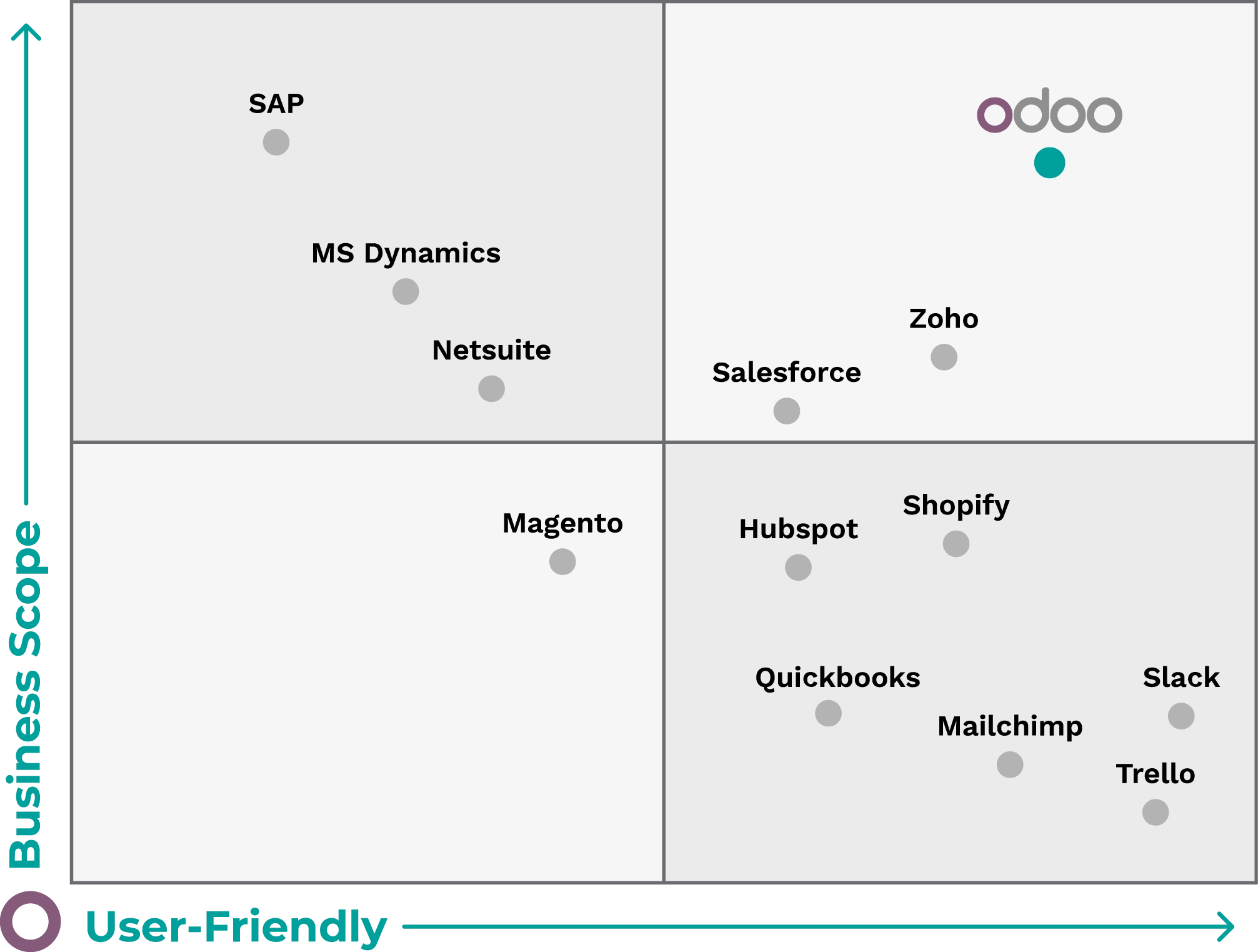
A necessary premise: **Salesforce** is a **CRM software**, whereas **Odoo** is an **ERP software** that encompasses various modules catering to different business areas (HR, accounting, warehouse, production, etc.).
Indeed, there would be nothing unusual about using both Salesforce and Odoo by integrating them, but let’s get to the point.
\[INDICE\]
- [\[#1\] Integrated System](#sistemaintegrato)
- [\[#2\] Agile Customization](#personalizzazione)
- [\[#3\] Scalability](#scalabile)
- [\[#4\] Open Source and Accessible Code](#opensource)
- [\[#5\] Costs](#prezzi)
### 1\. Integrated System
Starting with the aforementioned difference, Odoo contains **multiple applications** (modules) such as CRM, Human Resources, Website, accounting, warehouse, and more – all integrated with each other. This eliminates the need to purchase and configure **additional integrations**.
### 2\. Agile Customization
One of Odoo’s strengths is undoubtedly its high degree of **platform customization**, a characteristic likely stemming from the open-source logic around which the software was developed.
Odoo enables customization of the interface, modules, and workflows according to a company’s specific needs without requiring integrations with third-party software.
### 3\. Scalabilità
Odoo’s architecture makes it a highly **scalable system**. You can start with 2-3 modules and then expand the scope of functionalities, adapting the software to the company’s needs. Unlike Salesforce, which might incur higher costs as a company’s needs grow, Odoo is suitable for startups or, more generally, for companies with **evolving** and **growing** structures.
### 4\. Open Source and Accessible Code
Odoo was born and owes its development to the **Open source** formula. Odoo maintains a **Community version** (Open source), but it ensures a considerable degree of customization even in the **Cloud version**. It provides Partners and developers with the [odoo.sh](https://www.odoo.sh/) platform for code and functionality development and testing before production deployment.
### 5\. Costs
What makes Odoo appealing to many entities is undoubtedly its **cost**. Odoo Community Edition is free, while the cloud version entails a monthly or yearly fee starting from 11.90€/user/month, along with a range of advantages and functionalities not present in the Community version.
A price point that is undoubtedly highly competitive, especially when considering that you’re not just purchasing a **CRM** but an **ERP software**.
Would you like to know more?
[Find out more](https://www.e-time.it/en/odoo-erp/index.md)
[Read More](https://www.e-time.it/en/odoo-vs-salesforce-5-reasons-to-choose-odoo/index.md)
[](https://www.e-time.it/en/it-asset-management-guide-en/index.md)
March 31, 2021by [user](https://www.e-time.it/en/author/user/index.md)[Other](https://www.e-time.it/en/category/other/index.md)
## [IT Asset Management – the benefits of having your company’s assets under control](https://www.e-time.it/en/it-asset-management-guide-en/index.md)
Efficiency and savings. This could be in extreme summary the answer to the question “What are the benefits of IT Asset Management?”, but let’s try to go by points.
## Why we talk about IT Asset Management
_**IT asset management (ITAM)** is the set of business practices that join financial, contractual and inventory functions to support life cycle management and strategic decision making for the IT environment. Assets include all elements of software and hardware that are found in the business environment. (def. [https://en.wikipedia.org/wiki/IT\_asset\_management](https://en.wikipedia.org/wiki/IT_asset_management))_
With IT Asset Management we indicate all the activities aimed at a correct **mapping and management of IT assets** (both software and hardware), integrating the different solutions between the various departments with a single macro objective, that of creating value for the company.
Most companies perceive the need to renew technologically and “invest in IT”, but perhaps it is not yet perfectly clear how and perhaps not even why.
The **enterprise market** is still divided into two broad categories:
- **Traditionalist**: it’s always been done this way; it’s always worked; now that so many are changing to follow the trend, it frees up space and I’ll be even better off.
- **Innovative**: the market will always evolve and the only way to compete is to (r)innovate.
Ignoring, or worse, hindering innovation, is like ignoring life.**
The world is inexorably accelerating toward valuing ideas.**
3D printers, which were in the science fiction dreams of the children of the last century, are now an evolving reality. Always new ideas that require a Time To Market as close to the immediate as possible. The only way to shorten the Time To Market is to use technology, IT.
After the birth of the first portable phones, a phone that could be a computer, a camera, a radio, a TV, etc…, arrived on the market even before the masses could even imagine it. This is an **effective Time To Market**! We believe that this acceleration will continue and therefore believe in the need to ensure that the IT of all companies is not only adequate and performing, but that it is considered an integral part of the company’s business lines on a par with people; that is, that it is considered on a par with human capabilities.
Man-machine interaction is no longer even to be considered an “innovation”, but a fact.
## Why should a manager be entitled to demand the best from his human staff without paying attention to IT resources?
Why are people **assigned** goals, while IT is **asked** what it can do to help achieve a goal?
And so why should a company be concerned about getting the most out of each of its **Human Resources** by seeking them out carefully, putting them in the best possible working conditions, incentivizing them, creating teams that know how to integrate in the best way, etc… and should not give the same attention to **IT resources**?
The answer is that perhaps you are still trying to put the famous “man with a red flag” in front of man/machine iteration innovation.
**IT Asset Management**, or rather, **IT Governance** more generally, shifts the role of IT from “IT Resource” to “Business Resource.” And as a business resource, like a human, it must be managed, valued and evaluated. If, for example, I am willing to spend a total of € for a designer, it is because I have had the opportunity to evaluate his work, through interviews, verification of the projects done, and whatever else, that his work will help to bring “adequate revenues” to the company.
**IT Asset Management is the tool that allows me to understand what resources (IT) I need, how my resources (IT) work, how much my resources (IT) really cost, what criticalities/problems my resources (IT) have and whether they give the business the expected contribution in order to bring “adequate revenues”.**
It is not uncommon, for example, for companies to set “standards” for IT purchases and for these to be defined by the average technology level in the market.
With adequate information, one could instead, for example, find that such a critical business line is served by certain IT assets for which we could consciously aim for TOP level purchases, while for other less critical business functions, aim for adequate levels saving money and satisfying my critical business much more.
The absence of these procedures sometimes leads to misguided investments that trigger vicious cycles that end up relegating IT to the sad role of “necessary cost” instead of “business investment”. Like human resources, IT investments must be carefully evaluated, measured and examined for the value they provide in terms of ROI.
From these observations, it is easy to see why all companies should incorporate an IT management strategy with a long-term view into their structure in order to strengthen competitiveness in response to market needs.
## Who is in charge of it?
Continuing the parallelism between the contribution of HR and IT to the business, as there is an HR Manager who reports directly to top management, the ideal, as many companies have already done, is the establishment of the figure of the **Asset Manager**. A figure capable of identifying and implementing the strategies necessary to reconcile the needs of the business with those of the IT resources available.
Where this figure is still absent, the **IT manager** is the most suitable figure to fill the role, provided that he knows how to “raise his head and see the business” with which to work closely.
However, Asset Management should be of equal interest to senior management as other resources (HR) that contribute to the business. **On the good health of the assets (HR and IT) depends the profitable administration and overall competitiveness of the whole company.**
## Benefits of IT Asset Management
As we’ve learned for decades now, a company made up of people who are capable, competent, know how to work as a team, and above all are motivated, brings great benefits. Likewise, an IT:
- **capable** (match needs/machines);
- **competent** (analysis of market availability/custom development);
- **who works in a “team”** (…interconnected to the business);
- **motivated** (…business objective defined for each IT process) also brings great benefits.
A sound and effective **IT Asset Management** system consistent with business objectives promises:
- **Risk reduction** (criticality control and proper calibration of systems).
- **Reduction of costs** (more efficient management of IT resources through proper management of maintenance or replacement of assets).
- **Improved IT performance** (load control, mapping of critical paths, etc.).
- **Intervention traceability** (knowledge of the interrelationships between assets allows the identification of the “criticality” of each planned/proposed intervention and to plan it correctly and without unexpected risks).
- **Performance traceability** (the effectiveness of the systems is verified as the business grows and possible evolutions are planned)
[Read More](https://www.e-time.it/en/it-asset-management-guide-en/index.md)
January 12, 2021by [user](https://www.e-time.it/en/author/user/index.md)[Other](https://www.e-time.it/en/category/other/index.md)
## [The addon that solves problems with OAuth2 protocol](https://www.e-time.it/en/oauth2-authentication-plugin/index.md)
## The addon that solves problems with the OAuth2 protocol
Although there are no definite terms yet, **Google and Microsoft** will end the support for authentication through username and password for **IMAP** and **POP3** services, making it **mandatory** to switch to the **OAuth 2.0 protocol**.
In order to adapt your **((OTRS)) Community edition** installation to the new protocol, our Rexpondo team has implemented the [REXOAuth2 plugin](https://www.rexpondo.com/rexoauth2-oauth-otrs-rexpondo/).
More information about the plugin is available on our website [rexpondo.com](https://www.rexpondo.com/)
### What is OAuth2
**OAuth 2** is the second version of the OAuth framework, an **authorization protocol** that allows applications to gain limited access to user accounts on an HTTP service
It works by delegating user authentication to the service hosting the user account and authorizing **third-party applications** to access the user account. OAuth 2.0 provides authorization streams for web and desktop applications and mobile devices.
[Read More](https://www.e-time.it/en/oauth2-authentication-plugin/index.md)
-
- [1](https://www.e-time.it/en/category/other/index.md)
- [2](https://www.e-time.it/en/category/other/page/2/index.md)

E-time is a Software House and System Integrator specialized in IT consulting web based and mobile software development for companies, banks and insurance companies.
 
#### Services
#### Solutions
#### Quick Links
[Facebook-f](https://www.facebook.com/etime.engineering/) [Linkedin-in](https://www.linkedin.com/company/e-time-s-r-l-) [Youtube](https://www.youtube.com/channel/UC--BH5mdqdEg2xQn96RX-GA) [Instagram](https://www.instagram.com/_etimesrl_/)
© 2026 E-time Srl. All Rights Reserved | P.IVA IT03256040233
18598